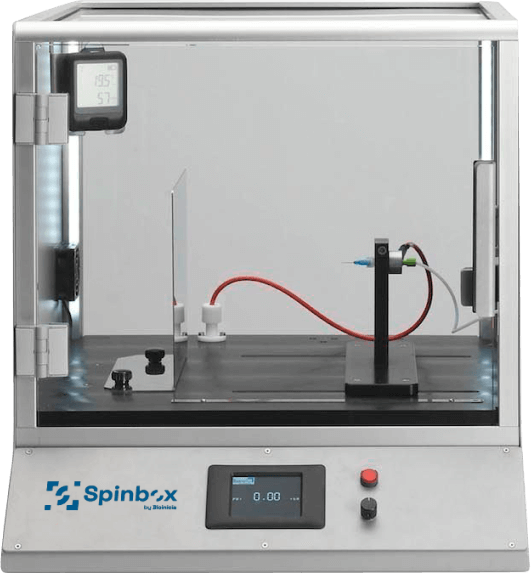
It is ideal electrospinner lab equipment for new solutions in early stages of your R&D project. Spinbox provides a great flexibility and versatility for researchers during experimentation.
Any concept-tested solution in Spinbox can be eventually moved to equipment in the Fluidnatek range for optimisation, scaling and manufacturing.
Cost-effective and safe electrospinner for users with little experience in electrospinning or for a first approach to electrospinning and electrospraying.
In terms of user safety, the Spinbox electrospinning system offers safety measures which go far beyond than any home-built system: closed chamber, exhaust ventilation system, safety interlock in case anyone opens the door (total shutdown), a design that prevents static electricity discharges, automatic fire extinguisher, compliant with EU regulations on electrical safety, etc. Professional electrospinner providing high safety levels.
If you have little experience in electrospinning, we provide 3 pre-configured Spinbox Kits to meet anyone’s needs and budget: Basic Spinbox Kit, Intermediate Spinbox Kit, and Advanced Spinbox Kit. Select the electrospinner configuration that suits you best!
| Feature | Spinbox Specification | Why It Matters |
|---|
| Equipment Type | Modular bench-top electrospinning and electrospraying instrument for lab-scale fabrication | Enables flexible research workflows and proof-of-concept development in basic R&D, within a compact, safe laboratory setup. |
| Research Focus | Designed for basic research, education, and early-stage material development | Simplifies adoption with a cost-effective system, while supporting multidisciplinary experimentation and process exploration. |
| Experimental Flexibility | Plug & Play modular upgrades, multiple collectors, coaxial and triaxial spinning, multi-emitter spinning injectors, needle-based and needle-less electrospinning technologies available… | Allows researchers to expand experimental capabilities, to try different machine configurations, to test a broad range of polymers and solvents, and to investigate complex electrospun or electrosprayed material architectures without replacing the platform. |
| Construction | Anodized aluminium, powder-coated steel, and glass | Provides a chemically resistant and easy-to-clean structure. |
| Footprint | 40–60 kg | 500 mm x 550 mm x 532 mm | Optimized to fit small spaces in laboratories, thus requiring a compact yet versatile research platform. The Spinbox system can be located even in the fumehood. |
| Voltage Range | 0 to +30 kV. Negative high-voltage source (optional) | Provides stable operating conditions for electrospinning and electrospraying process development, by adjusting and optimizing both the positive voltage for emitter and the negative voltage on the collector, improving the fiber or particle deposition onto the collector. |
| User interface | LCD screen on the equipment and the external modules, as well as control via external computer | Allows spinning parameter adjustments without opening the chamber, helping preserve process stability, increasing safety and minimizing operator exposure to solvent vapors. |
| Exhaust system | Exhaust fan to extract the solvent vapours | Solvent vapours of organic solvents can be harmful, the exhaust fan manages to extract the solvent vapours through the fumehood in the laboratory. |
| Spinning configuration | Horizontal and vertical spinning | For some processes top-down spinning is required (e.g. when collecting electrosprayed particles in a liquid bath), whereas for other process horizontal spinning may be more suitable. Full flexibility to do either vertical or horizontal spinning. . |
| Emitter-Collector Distance | Horizontal spinning: 50–240 mm; Vertical spinning: 50–162 mm | Supports fine adjustment of the spinning distance (process parameter) to optimize the process. |
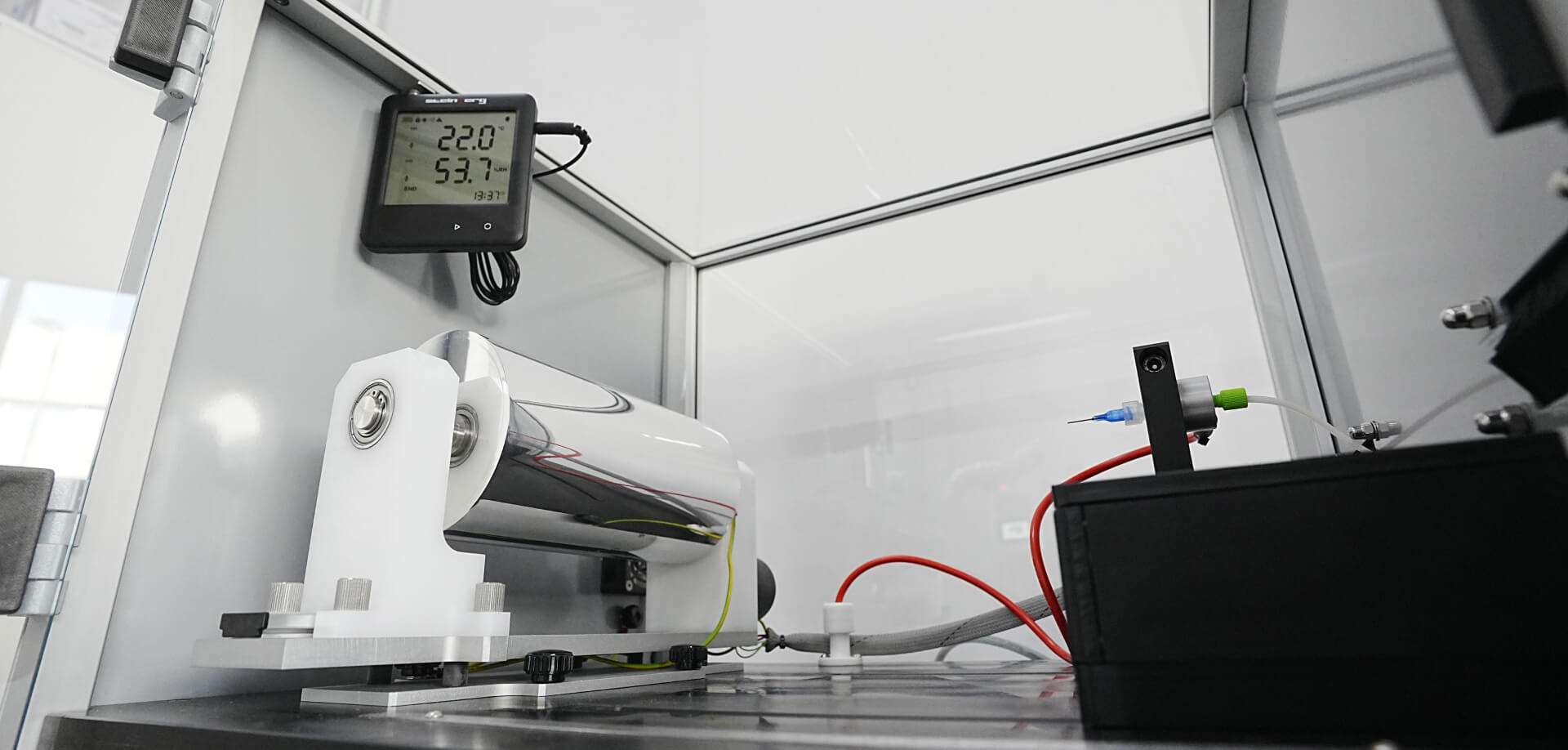
| Collector Types Available | Flat plate collector, drum, mandrel, and disc collectors | Enables random deposition, aligned fibers, tubular structures, and particle collection workflows. In each process the most suitable collector can be installed, quickly and easily. . |
| Spinning modes and injectors | Single-phase, coaxial or triaxial spinning; multi-emitter spinning injectors up to 10 emitters | Supports higher-throughput experimentation and development of advanced multi-layered structures (core-shell structures). |
| Solution Feeding System | Up to 3 syringe pumps, and/or pressure vessel feeding, and/or tubeless solution dispensing system | The user decides whether syringe pump system or pressurized vessel system is more appropriate for the solution feeding. Likewise, using alternatively the tubeless solution dispensing system minimizes the dead volume in the tubing, improves material handling efficiency, and supports expensive formulations (saving cost by substantially reducing the solution wastage). |
| Process Homegenity | Automated scanning emitter motion (back-and-forth injector movement) | Adjustable, precise back-and-forth spinning injector movement, enables a higher homogeneity of electrospun fiber deposition across the collector. |
| Process Monitoring | Taylor cone visualization system, and sensor for temperature and relative humidity | The Taylor cone visualization system allows the operator to observe the so called Taylor cone in real time; the Taylor cone shape and stability gives an indication of how stable or not a process is. Therefore, it helps to accelerate research. Likewise, the sensor for temperature and relative humidity measures the environmental conditions in the chamber, which largely affect the materials produced by electrospinning or electrospraying. |
| Safety Features | Safety door interlock, exhaust system, grounded chamber, solvent-resistant enclosure, automatic fire extinguisher system | Supports safe laboratory operation while reducing operational risk and solvent exposure. |
| Compliance | CE compliant and independently verified | Reinforces confidence in laboratory integration, teaching environments, and research workflows. |
What is the Spinbox electrospinning system?
Spinbox is a compact and modular electrospinning and electrospraying platform designed for basic research, proof-of-concept studies, and early-stage material development. Whether in academia or at industrial companies in preliminary research stages. It’s the ideal electrospinning system, cost-effective while maintaining high performance and reliability, for researchers who want to have a first approach to electrospinning and electrospraying.
What makes Spinbox a flexible research platform?
Its Plug & Play modular architecture supports multiple spinning arrangements, including vertical or horizontal spinning, interchangeable collectors, coaxial and triaxial spinning, different solution feeding systems for different requirements and applications, support for processing with a single emitter and up to ten emitters (multi-emitter spinning heads), needle-based and needle-less technologies available, and configurable process monitoring tools. All these features can be upgraded at any time by the user, with a simple Plug & Play installation.
What applications can be developed with Spinbox?
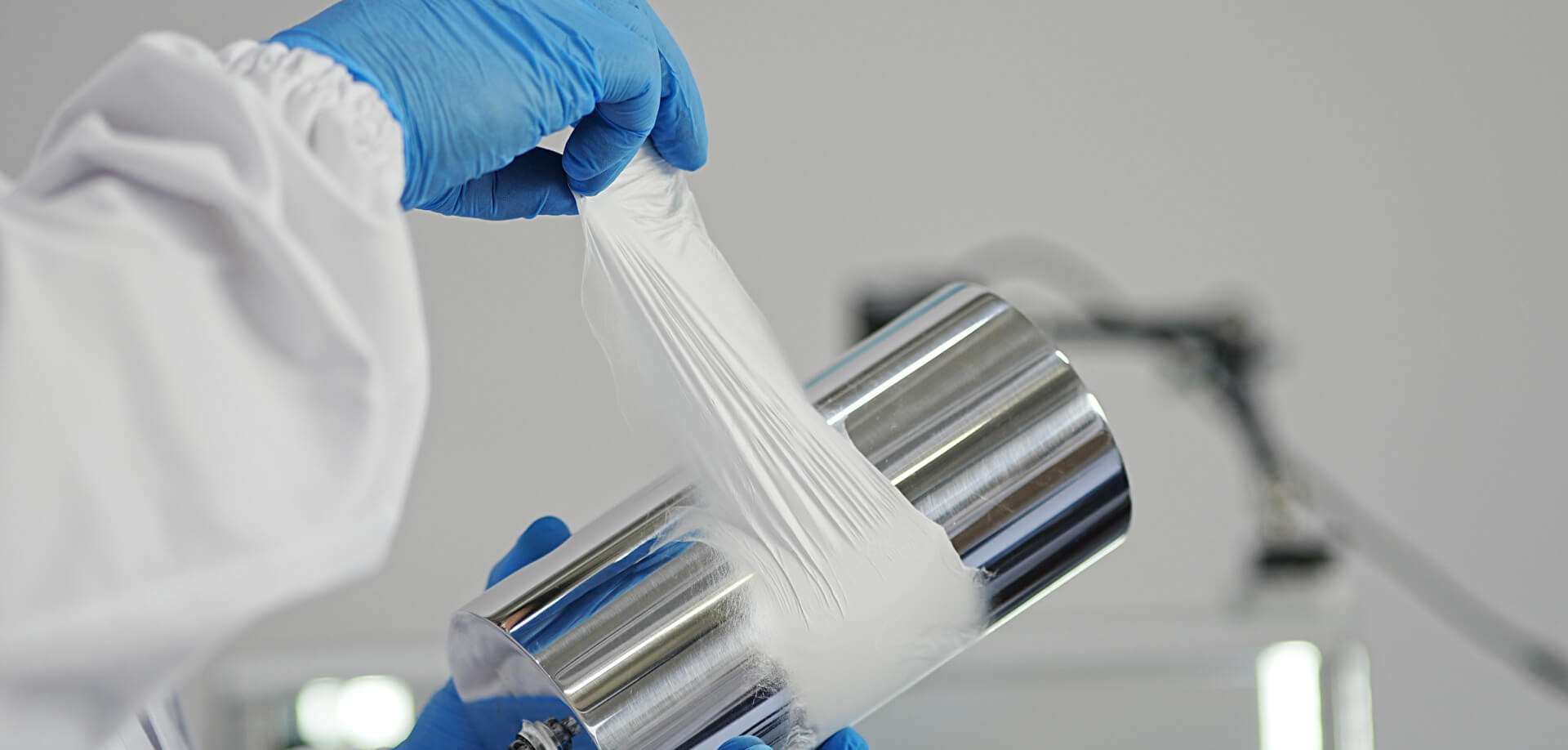
Spinbox electrospinning equipment supports research involving nanofibers, particles, coatings or tubular structures, in applications such as regenerative medicine, medical devices, wound healing, technical textiles, catalytic membranes, drug delivery, filtration, and advanced material development, amongst other possible applications.
How does Spinbox support optimized reproducible experimentation?
Optional monitoring tools such as temperature and relative humidity sensing, Taylor cone visualization, and adjustable, automated scanning emitter motion, help researchers optimize operating conditions and improve process consistency.
What safety features are integrated into Spinbox?
The system includes a safety door interlock, grounded chamber, exhaust system, solvent-resistant materials, and sealed cable pass-throughs for safer laboratory operation. An optional automatic fire extinguisher system is also available.
Can processes developed on Spinbox be scaled later?
Yes. Recipes and process parameters and configurations developed on Spinbox, can be transferred into more advanced Fluidnatek electrospinning systems enabling a deeper process optimization and expanded process development, as well as future scale-up and manufacturing.
Modular Design for High Flexibility at Research
Spinbox electrospinning machine is designed to support evolving research requirements while maintaining a compact laboratory footprint. Its modular architecture enables researchers to investigate a broad range of electrospinning and electrospraying configurations from a single adaptable platform, while allowing future upgrades on the equipment as research needs evolve.
Plug & Play Expansion for Evolving Research
Researchers can continuously expand experimental capabilities through interchangeable collectors, coaxial and triaxial spinning configurations, advanced feeding systems, and additional process monitoring tools. This modular approach allows laboratories to explore new hypotheses, materials, and nanostructures without workflow disruption or equipment replacement. Also, users can purchase and incorporate new upgrades whenever needed or wanted, so that the Spinbox electrospinning system can deliver new functionalities, meeting the process requirements at any time.
Controlled Process Conditions for Optimized Development
Process monitoring technologies, including Taylor cone visualization, scanning emitter motion for a more uniform fiber deposition across the collector, precise voltage adjustment, precise solution feeding, and T/RH precision sensing, help researchers better understand process behavior and accelerate its optimization. These functionalities contribute to stable operating conditions, reduced experimental variability, and improved reproducibility across development cycles.
Safe and User-Friendly Research Operation
Spinbox electrospinning system combines simplified operation with integrated laboratory safety features, helping researchers to focus on innovation and process development rather than operational complexity or risks.
Integrated Safety Features for Laboratory Environments
The Spinbox electrospinning machine incorporates a safety door interlock, electrically grounded chamber, solvent vapor extraction system, automatic fire extinguisher system, and sealed cable pass-throughs to support controlled and safer operation during electrospinning and electrospraying processes.
Reliable Laboratory Integration
Spinbox electrospinning equipment is CE compliant and independently verified, reinforcing confidence in academic, teaching, and proof-of-concept research environments where reliability, flexibility at research and safety are required.
Broad Material and Application Possibilities
Spinbox electrospinning setup supports the fabrication of a wide variety of nanostructured materials by electrospinning and electrospraying techniques, including nanoscale and microscale fibers, porous structures, particles, coatings, flat sheets, and tubular architectures.
From Nanofibers to Functional Particles
The Spinbox platform supports both electrospinning and electrospraying, enabling research across applications such as tissue engineering, drug delivery, filtration, regenerative medicine, medical devices, wound healing, material science, technical textiles, catalytic membranes, and advanced coatings.
Advanced Configurations for Complex Structures
Optional both coaxial and triaxial spinning to generate core-shell structures, and multi-emitter spinning configurations enable the development of sophisticated material architectures and higher-throughput experimental workflows. Additional solution feeding technologies, like the tubeless solution dispensing system, help improve formulation handling while minimizing material waste during process development.
Scalable Development Path within the Fluidnatek Equipment Range
Spinbox electrospinning machine enables laboratories to establish foundational process knowledge while maintaining a clear pathway toward future scale-up and advanced process development, as well as manufacturing, that can be driven through the Fluidnatek equipment range for electrospinning and electrospraying. This means the recipes and processes developed with Spinbox equipment can be directly transferred to the Fluidnatek equipment range.
From Early Research to Advanced Development
Recipes and process parameters developed on Spinbox can be transferred into more advanced Fluidnatek electrospinning platforms, helping reduce redevelopment effort and supporting workflow continuity across a deeper research and process optimization, scale-up stages, up to manufacturing stages (industrial production).
Compact Electrospinning Platform with Long-Term Research Value
By combining a compact footprint with modular configurability, high flexibility for research, and scalable process transfer, Spinbox provides laboratories with an highly versatile electrospinning platform capable of supporting both current experimental needs and future research expansion.
Scalability
Spinbox electrospinning system can serve as the first step within the broader Fluidnatek equipment portfolio, enabling process direct transfer into more advanced, sophisticated electrospinning platforms as research requirements evolve and become more demanding, also looking at process scalability and manufacturing in the last term.










 ESP
ESP